trust-runtime
trust-runtime is the main operator/runtime CLI for truST. Developer and
automation workbench commands are moving to trust-dev; deprecated
trust-runtime aliases remain during the migration window and will not be
removed before 2026-10-05. Removing them requires a separate behavior-change
release note.
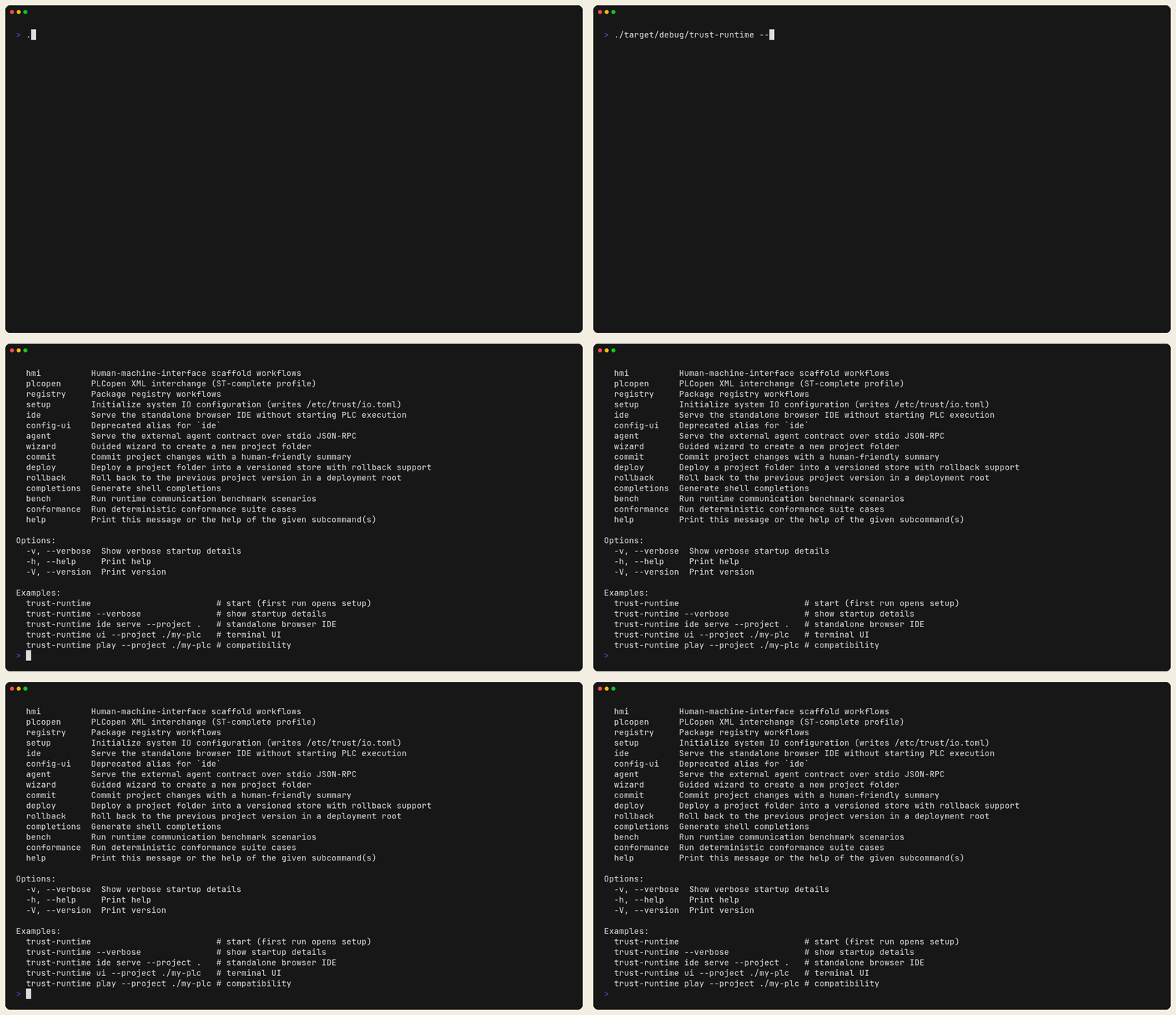
Figure: The top-level trust-runtime command families exactly as the shipped
binary reports them.
Top-level Command Families
| Command | Purpose |
|---|---|
run / play |
start a runtime instance |
ui |
interactive terminal UI |
ctl |
send control requests to a running runtime |
check |
validate sources/config without writing program.stbc |
build |
generate program.stbc |
validate |
validate project config + bundle |
test |
deprecated alias for trust-dev test |
docs |
deprecated alias for trust-dev docs |
hmi |
scaffold/update/reset hmi/ |
ads |
Beckhoff ADS onboarding backend, symbol import, route artifacts, and validation |
comm |
offline communication schema, configuration, discovery, topology, and symbol browsing |
plcopen |
PLCopen import/export/profile |
registry |
package registry workflows |
setup |
initialize system I/O config |
ide |
serve the browser IDE |
agent |
deprecated alias for trust-dev agent serve |
commit |
deprecated alias for trust-dev commit |
wizard |
create a new project folder |
deploy / rollback |
versioned deployment and rollback |
bench |
communication/runtime benchmark surfaces |
conformance |
deterministic conformance suite runner |
Entry-point and Error Contract
The top-level parser accepts --verbose before or after a subcommand. When a
subcommand is not recognized, the CLI computes a bounded edit-distance
suggestion against every shipped top-level command, ignoring global flags when
identifying the mistyped command. Suggestions are emitted only when the best
command is at most two single-character edits away; distant inputs receive the
normal usage error without an invented recommendation.
Errors returned to the top-level entrypoint exit with status 1 outside --ci
mode after printing the stable Error: prefix and any applicable configuration
tip. Commands with a documented machine contract, including check, may exit
directly with their stable command-specific status. In --ci mode, returned
errors use the documented command-aware CI exit classes for configuration,
build, test, timeout, and internal failures.
Common Commands
Check
Usage: trust-runtime check [OPTIONS]
check validates required runtime.toml and io.toml, optional ads.toml
and opcua_client.toml, the source/dependency layout, and compilation without
writing program.stbc. It aggregates independent configuration and compile
issues in one response instead of stopping at the first failure.
--json and --ci emit response version 1 with ok, status, issue counts,
stable issue codes, source/dependency lists, and the in-memory bytecode size
when compilation succeeded. Configuration or source-layout errors exit 10;
compile errors exit 11. A successful check exits 0 and never writes the
compiled bytecode artifact.
Build
Usage: trust-runtime build [OPTIONS]
Primary options:
--project--sources--ci
The default source root is <project>/src; relative --sources values are
resolved from the project. A successful build writes program.stbc. A failed
source, dependency, or compile step preserves any existing artifact. --ci
emits response version 1 with the output path and complete source/dependency
identity; build failures exit 11.
Validate
Usage: trust-runtime validate [OPTIONS] --project <PROJECT>
Primary options:
--project--ci
Test
Usage: trust-runtime test [OPTIONS]
This forwards to trust-dev test and prints a deprecation warning with the
2026-10-05 removal-not-before date.
Primary options:
--project--filter--list--timeout--output--ci
Docs
Usage: trust-runtime docs [OPTIONS]
This forwards to trust-dev docs and prints a deprecation warning with the
2026-10-05 removal-not-before date.
Primary options:
--project--out-dir--format
Agent
Usage: trust-runtime agent [OPTIONS] <COMMAND>
Compatibility subcommand:
serve
This forwards to trust-dev agent serve and prints a deprecation warning with
the 2026-10-05 removal-not-before date.
Communication
Usage: trust-runtime comm <COMMAND>
comm operates through the same communication configuration and inspection
contracts used by the IDE without requiring a running PLC runtime. Successful
responses are JSON objects with a command-specific schema_version; --json
is accepted on every subcommand for explicit machine-readable invocation.
Subcommands:
schemareturns the available protocol configuration schema and can filter it with--protocol.applyvalidates--paramsas a JSON object and appliesadd,edit,upsert,remove,disable, orvalidateto project configuration files.topologyprojects configured hosts, runtimes, endpoints, and links from project files. Configured state is not reported as live connectivity.discoverperforms host-local, connect/read-only discovery. Candidate confidence distinguishes protocol proof from a likely endpoint or mere TCP reachability; write probes are not supported.browse-symbolsreads a configured project, target, or cached ADS snapshot and returns the canonical tree/import response.opcua-trust list|clearinspects or clears the selected OPC UA client trust store.
Malformed --params, unreadable or invalid snapshot files, unknown protocols,
and configuration validation failures are returned through the normal
top-level error contract.
Commit
Usage: trust-runtime commit [OPTIONS]
This preserves --project, --message, and --dry-run while forwarding to
trust-dev commit. It prints a deprecation warning and will not be removed
before 2026-10-05; removal requires a separate behavior-change release note.
HMI
Usage: trust-runtime hmi [OPTIONS] <COMMAND>
Current subcommands:
initupdatereset
ADS
Usage: trust-runtime ads <COMMAND>
Current subcommands:
discover: find or identify TwinCAT ADS targets from the current host (ads-wirebuild required).browse: connect to one or all configured ADS client connections inads.tomland print the live symbol table (ads-wirebuild required).doctor: run the ADS connectivity Doctor from the current host (ads-wirebuild required). Supplying--target-net-idmakes a known target a first-class path: the Doctor uses that AMS Net ID instead of requiring UDP identify to succeed. Supplying--write-symbol,--write-type, and--write-valuetogether runs a guarded write probe that writes, reads back, restores, and verifies a safe writable PLC variable.route-script: generate PowerShell, StaticRoutes.xml, GUI, or removal route artifacts using explicit runtime-host identity values.add-route: send UDP AddRoute directly to the PLC. The TwinCAT password is accepted only through--password-stdin.import-symbols: authoring-only live symbol import that can dry-run generatedads.toml, snapshot, and ST files for VS Code/web diff review (ads-wirebuild required).import: generate deterministic ST globals from existingads.tomland cached ADS symbol snapshots.validate --offline: compare generated ST againstads.tomland cached symbol snapshots without opening a PLC connection.validate --live: upload live TwinCAT symbols for each configured connection and compare the checked-in generated ST against the live target (ads-wirebuild required).server status: query[runtime.ads_server]status from a running runtime control endpoint.server symbols: list the runtime globals currently exposed as ADS symbols.server doctor: run the ADS server Doctor against the running runtime. The loopback self-test alone is not external-client proof; pass--external-kindand--external-nameonly after an independent client such as pyads has completed its smoke.server route-script: generate route artifacts for external ADS clients or a TwinCAT engineering station so they can reach the truST ADS server.
The normal customer workflow starts in the VS Code ADS panel or the runtime
host setup page at /setup/ads; the CLI is the scriptable backend. Common
authoring and offline-validation workflow:
trust-runtime ads import-symbols \
  --target 192.168.10.5 \
  --target-net-id 5.23.91.12.1.1 \
  --connection line1 \
  --out ads.toml \
  --gen src/generated/ads_generated.st

trust-runtime ads validate --offline \
  --config ads.toml \
  --snapshot ads/snapshots/line1.symbols.json \
  --generated src/generated/ads_generated.st
Live validation uses the configured ADS routes:
trust-runtime ads browse \
  --config ads.toml \
  --connection line1

trust-runtime ads validate --live \
  --config ads.toml \
  --generated src/generated/ads_generated.st
Live runtime ADS I/O is not started by these CLI commands. It is enabled by
[runtime.ads] in runtime.toml and requires a runtime built with feature
ads-wire.
Offline ads import and ads validate --offline read ads.toml and cached
symbol snapshots without opening a PLC connection. Snapshot arrays are
canonicalized before generation so output is deterministic. Import creates
missing parent directories, reports changed: false when the generated file
already matches byte-for-byte, and refuses to replace different content unless
--force is present. Offline validation requires at least one snapshot and
reports generated-source drift with the first differing line.
Live discovery, browse, Doctor, guarded AddRoute, symbol import, and live
validation fail closed when the binary lacks the ads-wire feature; they do
not synthesize discovery or hardware results and do not write generated files.
Human output summarizes the same report objects emitted by --json; machine
consumers should use --json rather than parse styled terminal text.
ADS server mode is enabled separately by [runtime.ads_server] and requires a
runtime built with feature ads-server. Common server workflow:
trust-runtime ads server route-script \
  --route-name trust-runtime-line1 \
  --server-ip 192.168.77.10 \
  --server-net-id 192.168.77.10.1.1 \
  --format powershell

trust-runtime ads server status --project examples/communication/ads_server_basic
trust-runtime ads server symbols --project examples/communication/ads_server_basic
trust-runtime ads server doctor --project examples/communication/ads_server_basic
After an independent pyads smoke, attach that evidence to the Doctor report:
trust-runtime ads server doctor \
  --project examples/communication/ads_server_basic \
  --external-kind pyads \
  --external-name pyads-smoke
The ADS server proof ladder is intentionally split: loopback self-test, pyads independent-client proof, and real TwinCAT engineering-station validation are separate gates.
PLCopen
Usage: trust-runtime plcopen [OPTIONS] <COMMAND>
Current subcommands:
profileexportimport
Control
Usage: trust-runtime ctl [OPTIONS] <COMMAND>
Important control subcommands:
statushealthstatsio-readio-writeio-forceio-unforcerestartshutdownconfig-getconfig-set
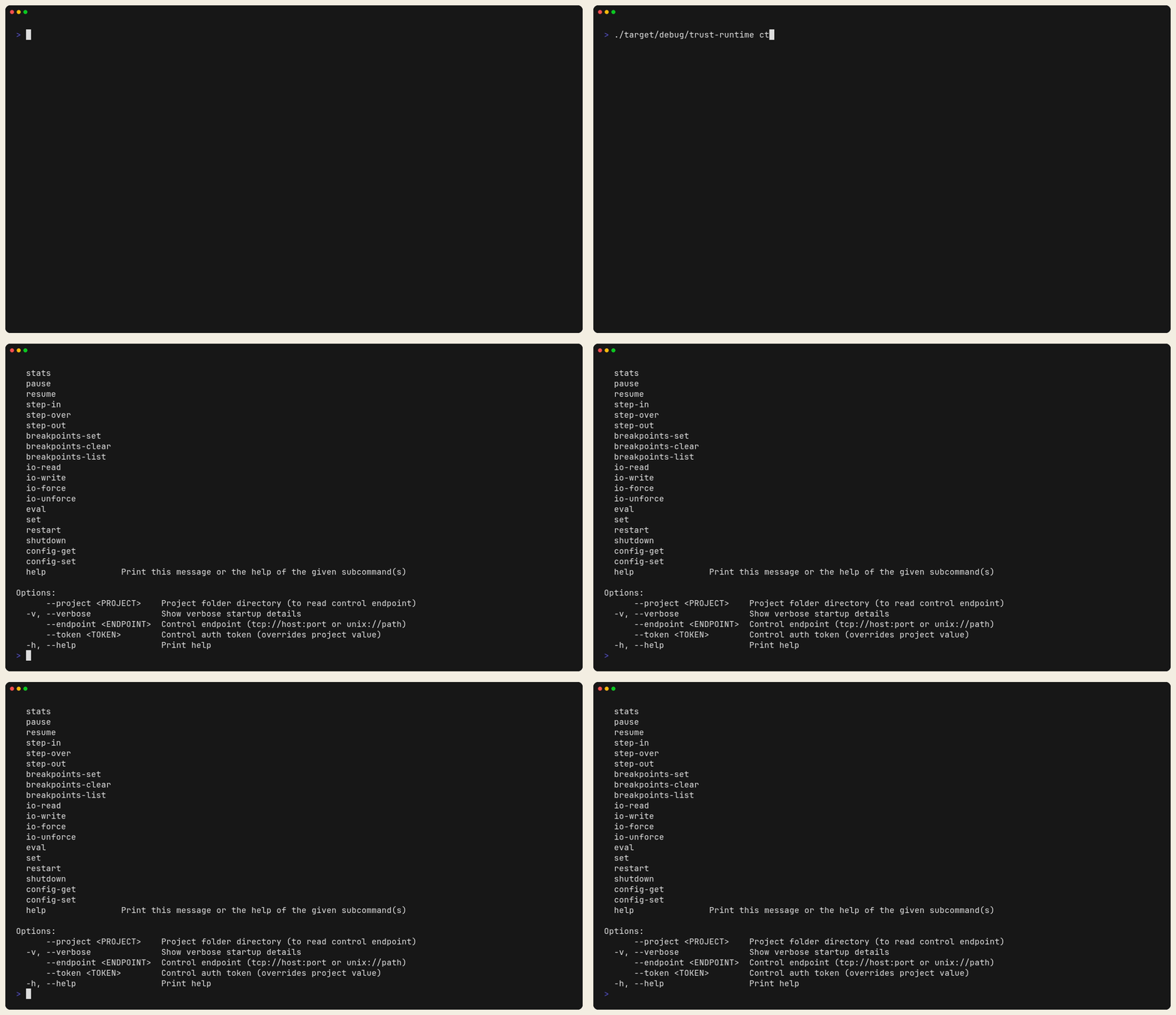
Figure: The ctl command family and its subcommands for the scriptable
control API.
Common Flows
Build / validate / test
trust-runtime build --project ./my-plc --sources src
trust-runtime validate --project ./my-plc
trust-dev test --project ./my-plc --output json
Start runtime
trust-runtime play --project ./my-plc
Run agent API
trust-dev agent serve --project ./my-plc
trust-runtime agent serve --project ./my-plc remains a compatibility alias
during the product/workbench split. It will not be removed before 2026-10-05,
and removal requires a separate behavior-change release note.
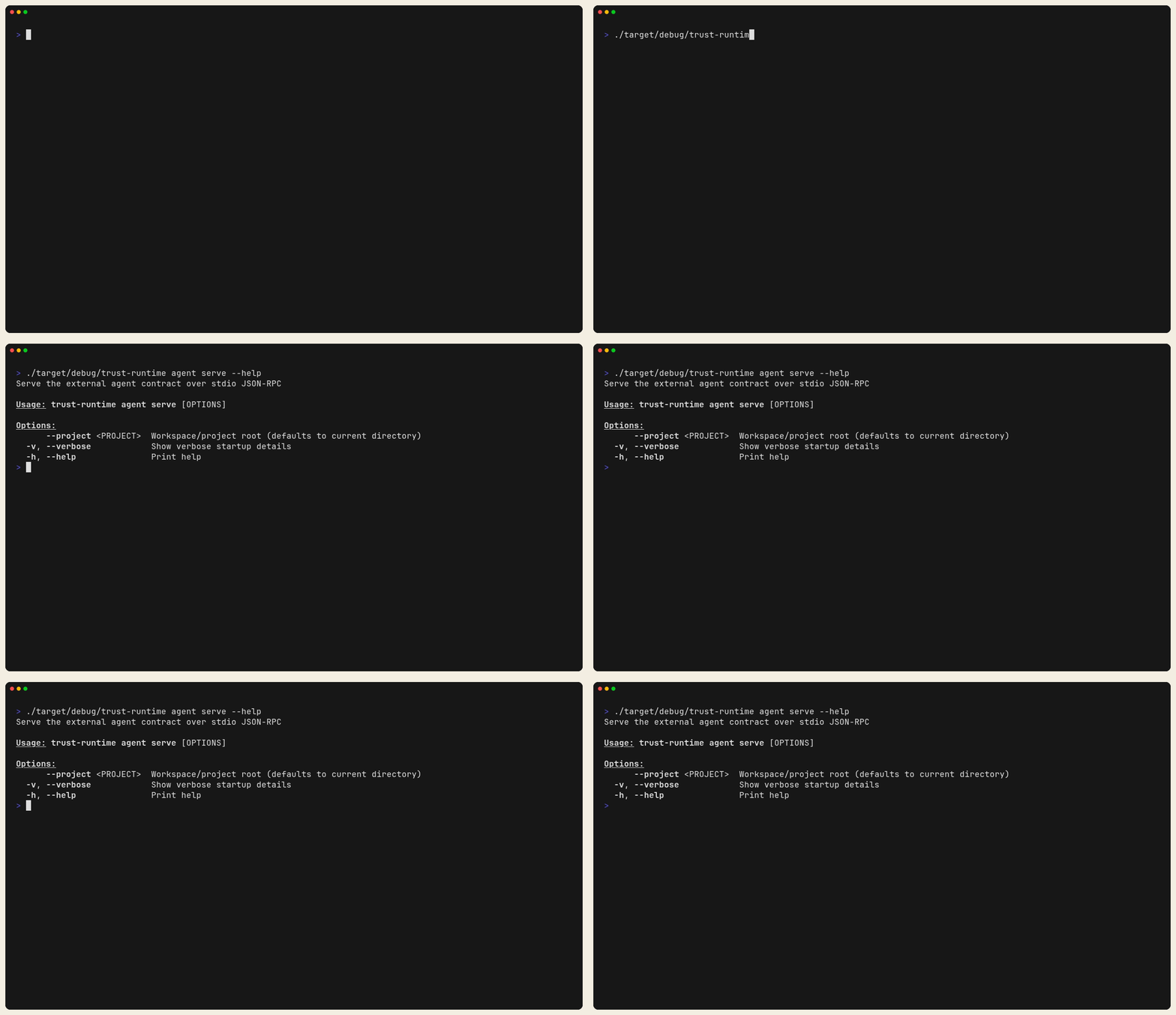
Figure: The agent serve entrypoint and its current stable flags. This is the
CLI contract agents and wrappers should target first.
Serve browser IDE
trust-runtime ide serve --project ./my-plc --listen 127.0.0.1:18080
--project defaults to the current directory and may name either one runtime
project or a workspace whose direct child directories are runtime projects. A
root-level runtime.toml is the primary runtime when present; otherwise the
first direct-child runtime.toml in lexical path order is primary. A malformed
selected runtime configuration stops startup. A directory with no runtime
configuration still starts with the neutral config-ui identity so the IDE's
Open Folder flow remains available.
The standalone control state loads the primary project's sources with the same
recursive, case-insensitive .st/.pou discovery and deterministic ordering
used by project builds, including configured local package dependencies. It
serves the IDE in standalone-ide mode with local authentication and does not
start a PLC scan cycle, discovery advertisement, or mesh transport. Runtime
operations that require an executing resource remain unsupported.
trust-runtime config-ui serve forwards to the same implementation and prints
a deprecation warning directing callers to ide serve.